

Survey Responses to Ebook: Build an Evidence-Based Guide
A survey can tell you what people struggle with, in their own words. It cannot write a credible book for you. A spreadsheet of responses has no narrative order, may contain personal information, and often mixes strong examples with comments that are too vague to support a claim. The useful job is to turn survey responses into an ebookwithout making the evidence sound stronger than it is.
This guide is for researchers, consultants, educators, and B2B creators who already have a survey with meaningful open-text answers. You will get a source-coding worksheet, a complete fictional example, a defensible chapter plan, and a way to test the resulting manuscript before paying for full generation. If you only need to share a chart from Google Forms, use the built-in export instead; a book workflow would add unnecessary work.
First, decide whether your survey contains a book
A customer satisfaction survey with one numeric rating and a free-text box may yield a short report or FAQ, not necessarily an ebook. A survey that asks experienced practitioners to describe obstacles, decisions, mistakes, and outcomes may contain enough material for a useful guide. The distinction is explanatory depth, not the number of cells in your spreadsheet.
Start with one sentence: “This guide helps [specific reader] make [decision or change] using [bounded evidence].” For example, “A guide for small design agencies to run clearer client handoffs, illustrated by responses to an onboarding survey.” That is a more honest promise than “What 200 agencies really think” if respondents were recruited from your own mailing list and the survey was never designed to represent the industry.
Export the responses, but do not upload the raw spreadsheet
Google documents a Responses → More → Download responses (.csv) option in its official Forms response guide. It also lets owners link responses to Google Sheets. Microsoft documents View responses → Open in Excelin its Forms response guide. These are export and analysis routes, not book-generation integrations. The exact controls can differ by account or interface.
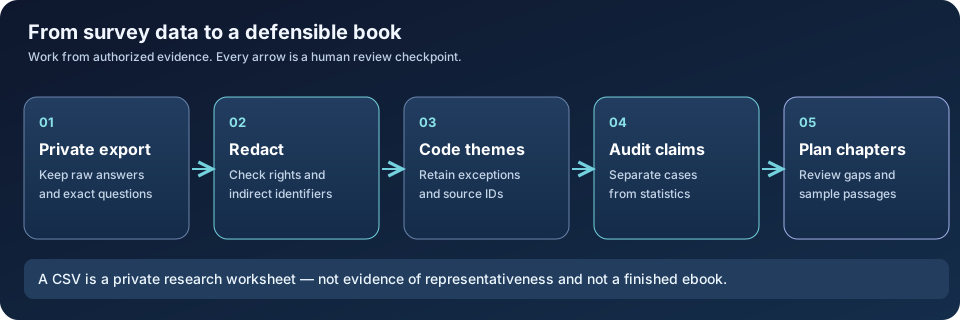
Keep the original export offline as your source of record. Make a working copy containing only questions and responses relevant to the proposed reader promise. Delete unnecessary names, emails, timestamps, client details, account numbers, and identifying combinations before sharing that copy. A row number is useful for tracing claims back to your private record; it should not become the identity of a person in the published book.
The European Data Protection Board distinguishes pseudonymisation from anonymisation: replacing names with IDs does not, by itself, make data anonymous. Small groups, unusual anecdotes, and combinations of attributes can still identify respondents. Check the survey notice, permissions, and any applicable privacy obligations before repurposing answers for publication. The worksheet is an editorial aid, not a legal assessment.
Code each open answer before asking AI for an outline
Read every eligible answer once without trying to write paragraphs. Assign short theme labels such as “unclear decision owner”, “missing assets”, or “late change requests”. A single response may support more than one theme. Keep a field for contradictory or positive cases, and preserve the survey question beside each answer so you can judge whether wording prompted the response.
Download the free survey-to-ebook coding worksheet (CSV). It has columns for question, short extract, theme, counterexample, sampling limitation, quote permission, identifiability risk, chapter destination, and a next editorial action. The six filled rows are fictional teaching data; blank rows are ready for your own redacted research. The CSV is a planning tool, not a Scribora source-upload format.
Coding matters because a prompt like “Summarize all responses and find the top five insights” can collapse conflicting experiences into one smooth story. The table makes disagreements visible. If three people describe the same obstacle, that tells you something about these three answers; it is not proof that most customers, or most businesses, have that obstacle.
A worked example: six fictional answers, three useful chapters
Imagine a small, fictional survey sent to design-studio operators: “What has made a recent client handoff difficult or easy?” Six synthetic responses were created for this tutorial. They are not Scribora customer data, not an actual survey, and not a basis for prevalence estimates.
| ID | Illustrative response | Code | Editorial use |
|---|---|---|---|
| F01 | We lost a week because nobody knew who approved the mockups. | Decision owner | Explain why approval authority belongs in a kickoff plan. |
| F02 | We began work before the client sent the brand files. | Missing assets | Illustrate a readiness checklist, not an industry statistic. |
| F03 | Requests came from several people after scope was agreed. | Change requests | Define how to route and review changes. |
| F04 | The handoff worked because our one approver signed off early. | Successful exception | Keep this case; it qualifies the story about failed approvals. |
| F05 | Three stakeholders asked for different revisions. | Decision owner / change requests | Show why the two themes interact. |
| F06 | We never said which materials had to arrive before kickoff. | Missing assets | Support an example of an explicit start criterion. |
In this constructed set, decision authority appears in F01, F04, and F05, but F04 describes something that worked. Missing inputs appear in F02 and F06; changes appear in F03 and F05. These observations suggest sections to write. They do not tell us what share of real studios experience the same problems. F04 should not be discarded just to sharpen a headline.
The complete worked example (Markdown) includes the raw synthetic answers, a traceable claim ledger, the chapter plan, a weak paragraph, and its evidence-aware revision. You can use the same method without pretending that an AI wrote or verified original research it never conducted.
Map themes to the reader's decisions, not survey questions
Survey columns are usually arranged in the order the questions appeared. That order works for data collection, but not for a book. A reader trying to improve a handoff needs to decide when work can start, who can approve it, and how changes are handled. Build that sequence from the reader's next decisions.
- Chapter 1 — Is the project ready? F02 and F06 motivate a missing-assets checklist.
- Chapter 2 — Who decides? F01, F04 and F05 illustrate approval boundaries and a successful counterexample.
- Chapter 3 — What happens when scope changes? F03 and F05 motivate a change-request protocol.
This outline is still incomplete. The responses describe problems, not a validated solution. An author must supply a defensible readiness checklist, approval template, and change process from their own expertise or properly cited sources. An AI system should not invent those procedures and attribute them to survey participants. Write the gaps down explicitly.
Protect the line between a response and a claim
For each sentence you plan to publish, record its type. Observation: an answer says something happened to one respondent. Interpretation: the author groups answers under a useful theme. Recommendation:the author proposes a method, ideally supported by separate experience or evidence. Prevalence claim: a numerical statement about a population that needs a defensible sampling method and denominator.
“Most studios lose a week during onboarding” would be unsupported by the six synthetic answers. “One response describes losing a week while approval ownership was unclear” is a faithful observation in the exercise. “Decide who can approve work before the kickoff” can be presented as the author's recommended practice, not as a measured finding. These are three different types of statements.
If your real survey has closed-ended questions, maintain denominators, missing-answer counts, recruitment method, and question wording. Do not interpret a self-selected sample as representative without justification. If the methodology cannot support a benchmark, publish a practical guide informed by survey feedback instead of a benchmark report.
What can you quote from survey respondents?
First check whether your participants were told their words might be republished, in which form and for what purpose. Avoid identifying stories unless the planned publication is properly cleared. Rewriting an answer does not automatically resolve privacy or permission issues. Where direct quotation is not appropriate, you may be able to discuss a general theme in your own words without reproducing personal information, depending on the rights and privacy context.
Record decisions as “cleared for this use”, “needs review”, or “exclude”, not just “name removed”. For very small samples, a quote can identify someone even without a name. Separate the private respondent key from the manuscript source extract. If the story cannot be used safely, leave it out.
Bring only the edited evidence into Scribora
You do not need to upload a Google Forms or Microsoft Forms export directly. Keep your coding CSV locally. Turn the selected, cleared themes into a short TXT, Markdown, or DOCX source document containing the question, the permitted extracts, source IDs, your notes, and explicit uncertainty labels. Scribora's source-format guidance covers text and document sources; it does not claim a dedicated survey-dashboard integration or general CSV survey import.
Then inspect the outline before generating a full book. Can every proposed chapter point to something in the source material? Which parts are author advice rather than survey findings? Which recommendations still need research or a real worked example? The outline review workflow is where to fix the manuscript structure, not after the prose has hidden the missing evidence.
Generate sample chapters, compare assertions against your private source ledger, and edit unsupported transitions. Scribora can export PDF or EPUB after generation, but it does not certify a study's methodology, grant quote permissions, or publish to a retailer for you. For a quality-review method, see the AI ebook evidence audit.
Choose an offer that makes sense for the survey
If you run a service business, a narrowly scoped survey-based guide can be a useful free diagnostic or lead magnet. A credible first chapter might help a prospect audit their current process, while the next offer supplies implementation. A paid research report requires stronger methodology and a clearer reason to buy than a collection of unsourced quotes. The lead magnet examples show where diagnostic guides and benchmark reports belong in different funnels.
Keep the landing-page promise matched to what the data can support. “A field guide built from real practitioner feedback” may be truthful if the research is real and authorized. “What the entire industry thinks” is not an acceptable shortcut when the data came from a convenience sample. Any source citations, limitations, and disclosure should travel with the ebook, not disappear after the landing page.
A 45-minute pilot to decide if this should become a book
- 10 minutes: define the target reader and one outcome; reject unrelated survey questions.
- 10 minutes: redact a working set, assign IDs, and mark every unclear publication permission.
- 10 minutes: code repeated themes plus at least one genuine counterexample if the data contain one.
- 10 minutes: make a three-chapter outline, with each intended claim pointing to a source ID.
- 5 minutes: list the missing explanations only the author or independent research can supply.
That pilot does not produce a publishable study or promise an ebook in 45 minutes. It answers a narrower question: do you have enough usable material to justify writing one? Download the worksheet and worked example, replace the fictional rows with your own cleared sources, and check the gaps before drafting.
If your survey suggests a real, specific guide, create a free Scribora project from selected, redacted notes. Review the outline and sample chapters before deciding whether a full manuscript is worth creating. That is a better test than turning an entire spreadsheet into a confident-sounding book in one step.
Product and external-source instructions checked November 7, 2026. Survey methodology, privacy rules, and export interfaces can vary; check your particular data and current provider instructions.